Wed 13 Jan 2021
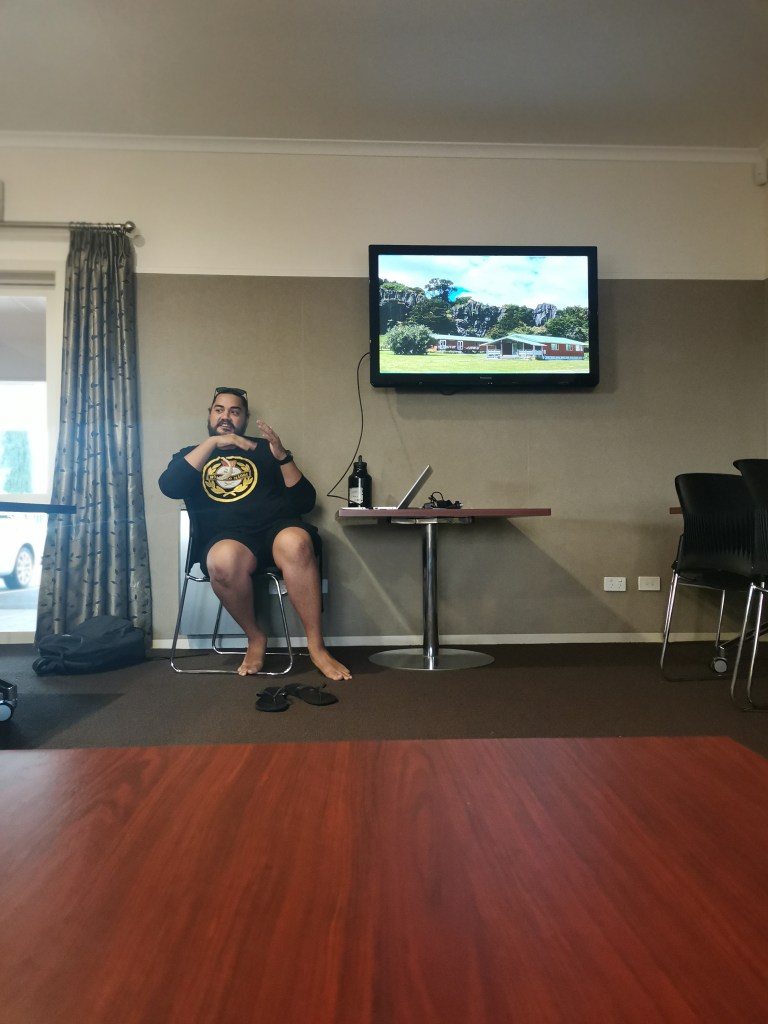
We had the opportunity to listen to both Teina Wells-Smith and my tuakana Moana-Aroha Henry share their teaching journeys at their respective schools: Teina at Whangārei Boys and Moana-Aroha at Whangārei Girls.
Why this experience impacted me:
This experience impacted me because these are the type of teachers I aspire to be like. Teina was able to beautifully and effortlessly interweave pūrākau and values that are so dear to my heart.
Moana-Aroha’s project made me feel so proud to be Māori. She engaged with her students and community and allowed them to call the shots. The results, as you will see, speak for themselves.
E kore te kūmara e kōrero mō tōna ake reka – Teina Wells-Smith
What I learned about Māori students and will take into my classroom:
- Privilege your knowledge: Teina’s project is one that is framed around his upbringing and pūrakau from his hapū of Ngāti Hine. Hineāmaru, he explains, is the ancestress from whom all of those who affiliate with Ngāti Hine (or Ngāti Hineāmaru) can claim descent. I found this impactful as I am also a tupu from the ‘maara o Hineamaru.’ For Teina, Hineamaru’s was a story of leadership, foresight, and sustainability. All three of these would form his project’s foundational values along with Māori values of manaakitanga and whanaungatanga as taught to him by his kuia and koroua.
- Have a guiding question for your project: the overarching research question for his project was; how can I give Māori students opportunities to experience science through Mātauranga Māori Scientists, increase Māori engagement in science as it did for him?
- What works for me, may well work for my Māori students: Teina’s research uses a personal approach of what worked for me, may well work for my Māori students. Will seeing science from a Te Ao Māori lens increase engagement by his Māori students? Will seeing Māori represented in science change how they feel about science? Is it because they’ve internalised negative societal views of their competence in this subject?
- Teach more (Delpit, 2006): when Teina first asked the students why they don’t like science, their answer was, “it’s because I’m too dumb.” Research has shown that deficit thinking and language are the reality of many mainstream schools (see Delpit, 2006). Marginalised students worldwide feel they are ‘lesser’ because they do not conform to the ‘norms’ of the hegemonic and neo-liberalist societies that they reside. No words are truer than those of Delpit (2006) when he advises teachers to build student resilience in our schools, to help them “cheat the system:”
“They must not only make children aware of the brilliance “in their blood” but also help children turn any internalized negative societal view of their competence into a compelling drive to demand that any system attempting to relegate them to the bottom of society must, instead, recognize and celebrate their giftedness”
Delpit, 2006, p.225
- Saturate your students in Te Ao Māori: with the students through the metacognitive and socio-constructivist process of wānanga and by exposing his students to Māori scientists, Teina could gauge and hold their interests. At one point, he brought in an artist to draw during Rereata Makiha’s workshop, so his students could reflect back on that experience in the future. O’Connor would have been proud (see Teaspoon of Light post).
- There is a place in the world for Māori, especially Te Ao Māori: The end goal for Teina was to show his students that Te Ao Māori has a place in science and in the world, and so do they.
- Create a sustainable framework, one that anyone can use: Teina created a spiral, cumulative and cyclic framework. Should Teina ever leave, the cycle will continue.
Teina’s Framework – He Kūmara, He Tangata
Teina came up with a sustainable framework consisting of four stages; plant, grow, harvest and replant. The framework is entitled He Kūmara, He Tangata.
- Planting stage – represents us (teachers). We are planted in the ground, and we bring those three characteristics, that leadership, foresight, and sustainability, for our students.
- Growth – we (teachers) grow into kūmara, which are nurtured with manaakitanga and whanaungatanga. Our students grow from us; they are the tuputupu.
- Harvest – we then harvest them to sustain our people, metaphorically and literally.
- Replant – tupu are cut, and these are replanted to grow more kūmara, so the cycle begins again.
Where to next?
Using ‘real context, real stakeholders, real solutions’, Teina engaged with his wider community to see how students can make a difference there. How can they become agents of change in those spaces? He recognises that to create Māori scientists, he must develop leaders. Leaders that can go against the currents of society. There were discussions where seniors wanted to create a teina and tukana partnership with their juniors.
Kia Kaha te Reo Māori – Moana-Aroha Henry
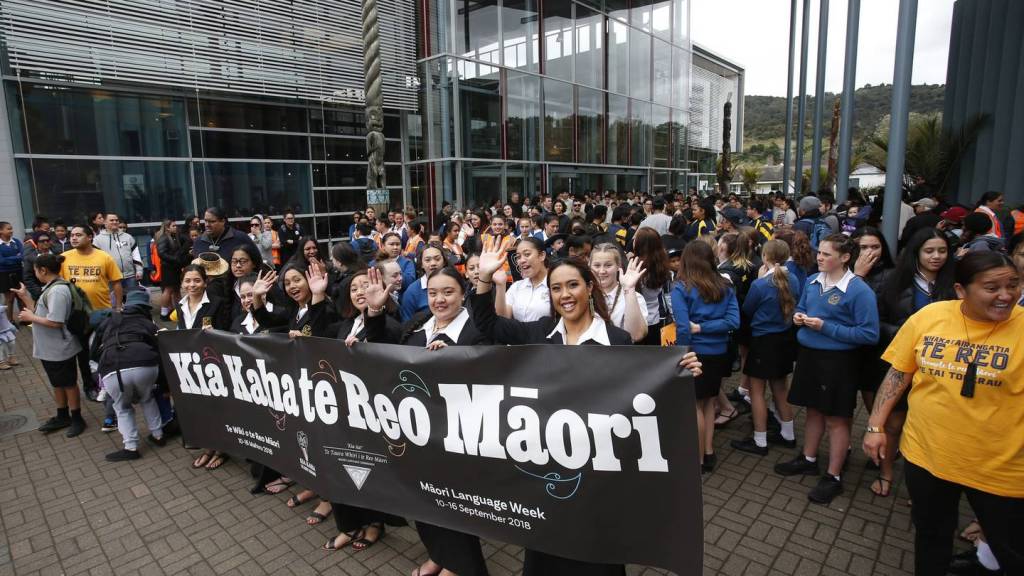
Moana-Aroha and her girls at Whangārei Girls High School organised a large hīkoi (parade) for Te Wiki o te Reo Māori in 2018 and 2019. In her kōrero she talks about the why, how and what of the kaupapa. Why was it important to organise this hīkoi? How did she and her girls go about organising this large event? What was the outcome of this kaupapa?
Watch Māori Television’s coverage of the 2019 hīkoi.
What I learned about Māori students and will take into my classroom:
- Organise a large community-based kaupapa: Moana-Aroha was trying to think of ways to have more Māori representation in the prefect roles. Her end-goal was to create proud Māori leaders, agents of change. She decided that to achieve this, they needed a big kaupapa.
- Run by students for students: that kaupapa was a large hīkoi for te wiki o te reo Māori in Whangārei. In 2019, over 2000 supported this kaupapa. What was even more amazing is that her project was mainly student-driven. Meaning, the girls project managed themselves by assigning roles. The girls decided:
- who would lead the hīkoi;
- who would stay behind to ensure that no one was left behind;
- who would cook and serve the sausage sizzle, as manaakitanga was important for them;
- who would communicate with funders and community organisations;
- who would organise whānau to come on board. It was a project that was driven by the students, for the students.
- How to get whānau involvement: It was hard to get whānau buy-in up until this point. Moana-Aroha discovered that “whānau will get involved if they feel they can be a part of something.” For her, it was about empowering her students and empowering her community. Co-constructivism, student-family agency, and just being genuine has been proven by many researchers to work (Bishop, 2005).
- Build your student’s resilience: during the march, they were faced with racism through the township of Whāngarei. It was a learning experience, one which Moana-Aroha harnessed to teach her girls to be resilient, to be resolute in their stance that “we are not going anywhere, and that we are doing this for our language.” By doing this, she was creating self-determining individuals (Delpit, 2006; Bishop, 2019).
- Know the system: Moana-Aroha explained that it was about “knowing the system” (personal communication, 14 Jan, 2021). According to Delpit (2006), to succeed, we must know the system to “cheat the system” because he’s right. The system is rigged. This is what Moana-Aroha meant when she said to get to know the system and how it works.
- Create more Māori leaders: this hīkoi project had another goal: to prepare them to become prefects in their school. Moana-Aroha knew that having Māori faces in those roles would encourage her girls’ teina (younger siblings) to aspire to those roles. If they can do it, then I can do it. So, Moana-Aroha made her girls apply for the prefect positions. The result was that 19 of the 30 prefects were from the Māori department. How awesome is that?!
- Prepare the student’s for success and for failure: Some did not, however, get the role they applied for. Pai tū, pai hinga – it does not matter if you succeed or fail. The main thing is how you get back up. For Moana-Aroha, the lesson was in the application process; it was preparing for life where you will win some and lose some. One of her girls who did not get the head girl position went on to become class precedent at her tertiary institution. Mate kainga tahi, ora kainga rua – when one door closes, another one will open.
Moana-Aroha’s Framework – Takarangi
As part of this framework, the students came up with their own whakatauākī. The design of the framework represents the whakairo (motif) that sits on the legs or the buttock area of a pūhoro (moko on the thigh). It was a spiral and dynamic design that encapsulated what they were doing, which was a hīkoi.
What I learned and will take into my classroom:
- Work with your students: Moana-Aroha had the girls come up with characteristics they believed made a great leader or prefect:
- Effective communicator
- Unite people
- Show that you care
- Show compassion
- Show integrity
- Humble
- Bilingual – can step into both worlds.
Standards and Competencies
Both Teina and Moana-Aroha are at Leader level in demonstrating Tātaiako competencies.
| Standard / Competency | Leaders |
| Standard 1: Te Tiriti o Waitangi partnership Demonstrate commitment to tangata whenuatanga and Te Tiriti o Waitangi partnership in Aotearoa New Zealand. | – Understand and recognise the unique status of tangata whenua in Aotearoa New Zealand. – Understand and acknowledge the histories, heritages, languages and cultures of partners to Te Tiriti o Waitangi. – Practise and develop the use of te reo and tikanga Māori. |
| Standard 4: Learning-focused culture Develop a culture that is focused on learning, and is characterised by respect, inclusion, empathy, collaboration and safety. | – Develop learning-focused relationships with learners, enabling them to be active participants in the process of learning, sharing ownership and responsibility for learning. – Foster trust, respect, and cooperation with and among learners so that they experience an environment in which it is safe to take risks. – Demonstrate high expectations for the learning outcomes of all learners, including for those learners with disabilities or learning support needs. – Create an environment where learners can be confident in their identities, languages, cultures and abilities. – Develop an environment where the diversity and uniqueness of all learners are accepted and valued. |
| Tātaiako: Whanaungatanga Actively engages in respectful working relationships with Māori learners, parents and whānau, hapū, iwi and the Māori community. | – Is visible, welcoming and accessible to Māori parents, whānau, hapū, iwi and the Māori community. – Actively builds and maintains respectful working relationships with Māori learners, their parents, whānau, hapū, iwi and communities that enable Māori to participate in important decisions about their children’s learning. – Demonstrates an appreciation of how whānau and iwi operate. – Ensures that the school/ ECE service, teachers and whānau work together to maximise Māori learner success. |
| Tātaiako: Manaakitanga Demonstrates integrity, sincerity and respect towards Māori beliefs, language and culture. | – Actively acknowledges and follows appropriate protocols when engaging with Māori parents, whānau, hapū, iwi and communities. – Communications with Māori learners are demonstrably underpinned by cross-cultural values of integrity and sincerity. – Understands local tikanga and Māori culture sufficiently to be able to respond appropriately to Māori learners, their parents, whānau, hap and Māori community about what happens at the school/ECE service. – Leads and supports staff to provide a respectful and caring environment to enable Māori achievement. – Actively acknowledges and acts upon the implications of the Treaty of Waitangi for themselves as a leader and their school/ECE service. |
| Tātaiako: Tangata Whenuatanga: Arms Māori learners as Māori – provides contexts for learning where the identity, language and culture (cultural locatedness) of Māori learners and their whānau is armed. | – Consciously provides resources and sets expectations that staff will engage with and learn about the local tikanga, environment and community, and their inter-related history. – Understands and can explain the effect of the local history on local iwi, whānau, hapū, the Māori community, Māori learners, the environment and the school/ECE service. – Actively acknowledges Māori parents, hapū, iwi and the Māori community as key stakeholders in the school/ECE service. – Ensures that teachers know how to acknowledge and utilise the cultural capital that Māori learners bring to the classroom in order to maximise learner success. |
| Tātaiako: Wānanga Participates with learners and communities in robust dialogue for the benefit of Māori learners’ achievement. | – Actively encourages, supports and, where appropriate, challenges Māori parents, whānau, hapū, iwi and the community to determine how they wish to engage about important matters at the school/ECE service. – Actively and routinely supports and leads stato engage eectively and appropriately with Māori parents, whānau, hapū, iwi and the Māori community. – Actively seeks out, values and responds to the views of Māori parents, whānau, hapū and the Māori community. – Engages the expertise of parents, whānau, hapū, iwi and Māori communities in the school/ECE service for the benefit of. |
| Tataiako: Ako Takes responsibility for their own learning and that of Māori learners | – Consciously plans and uses pedagogy that engages Māori learners and caters for their needs. – Plans and implements programmes of learning that accelerate the progress of each Māori learner identified as achieving below or well below expected achievement levels. – Actively engages Māori learners and whānau in the learning (partnership) through regular, purposeful feedback and constructive feed-forward. – Validates the prior knowledge that Māori learners bring to their learning. – Maintains high expectations of Māori learners succeeding as Māori. – Takes responsibility for their own development about Māori learner achievement. – Ensures congruency between learning at home and at school. |
 Te Kōpaki a Ruiha Epiha