Ako Inquiry 1 – Term 1, 2021
Ka koekoe te tūī, ka ketekete te kākā, ka kūkū te kererū
Whakataukī
The tūī bird squawks, the kākā bird chatters, and the kererū bird coos. I used this whakataukī or ancestral proverb to drive home the key understanding acquired from my first Ako Inquiry, and that is, the uniqueness of each tauira, as well as their unique learning needs.
Scanning of my classes
When I scanned my classroom at the beginning of term one to see what was going on for my tauira. Unfortunately, I saw that all my students enrolled to do NCEA Level 1 Te Reo Māori were not at the fluWhen I scanned my classroom at the beginning of term one, unfortunately, I saw that all my students enrolled to do NCEA Level 1 Te Reo Māori were not at the fluency level needed to do well.
My hunch
What then will help accelerate the learning process for my tauira? Will providing opportunities to engage with te reo Māori multiple times over in a scaffolded way and formative assessments (diagnostic templates in Van Hees, 1999) increase their fluency levels.
Screening Assessment
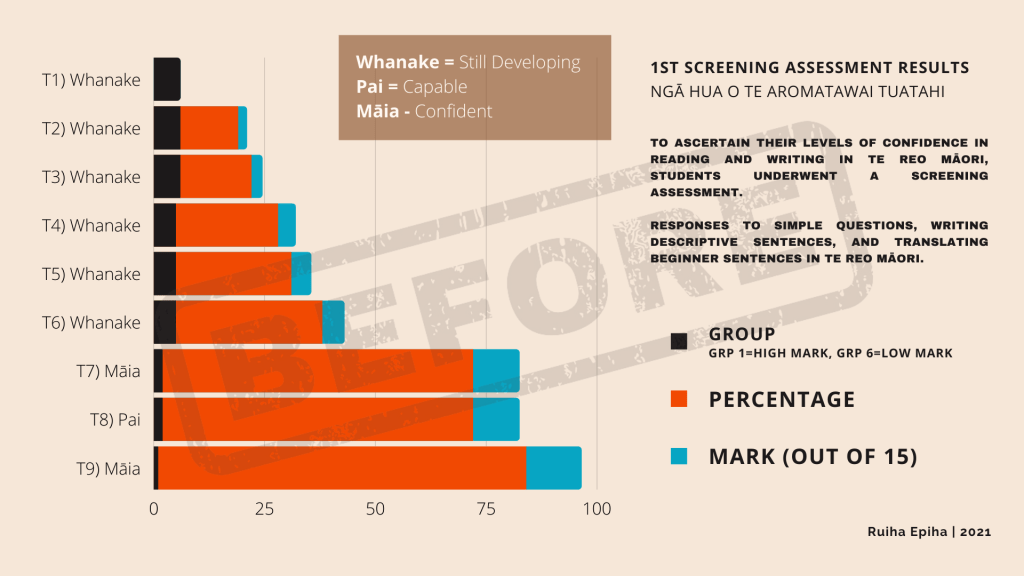
To gauge their fluency levels and the range of needs, I got these tauira to do a screening assessment at the beginning of term 1.
The results in Figure 1 suggest that most are still developing their fluency, with only a small group at the ”confident” or ”māia” fluency level.
The black represents the group, with group 1 scoring quite highly and group 6 scoring lower marks. The red represents their passing percentage, and the blue is their mark (out of 15).
What is the need?
Through whakawhanaungatanga (relational pedagogy in Bishop & Berryman, 2009) the screening assessment, group talanoa (Vaioleti, 2013), one-on-one discussions, and overall teacher judgment, I saw that the tauira needed differentiated (Tomlinson & Moon, 2013) options with heavy scaffolding (Applebee & Langer, 1983; Hogan & Pressley, 1997) to help accelerate their learning process.
What does differentiation look like in my classroom?
How is differentiation implemented in your classroom?
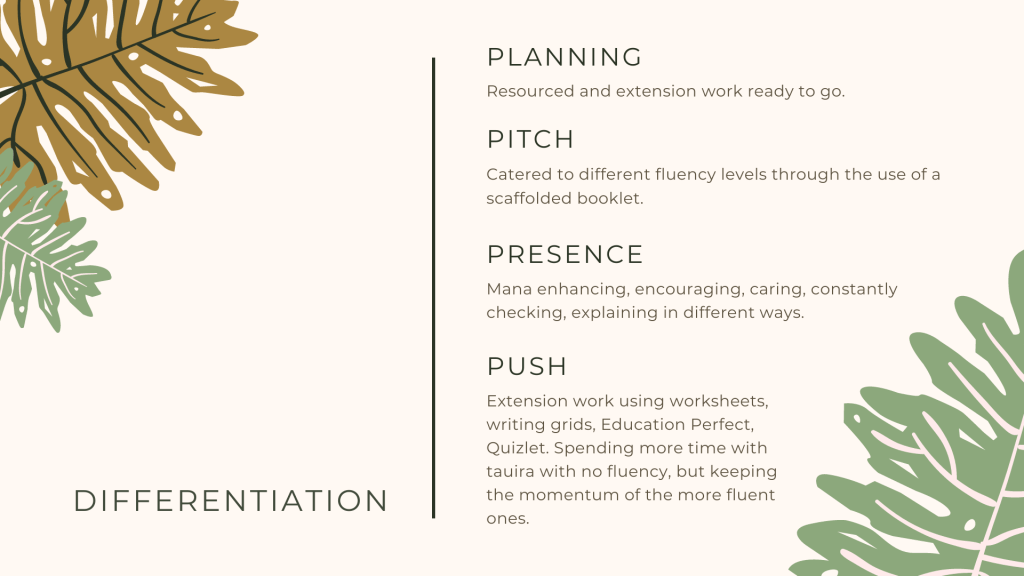
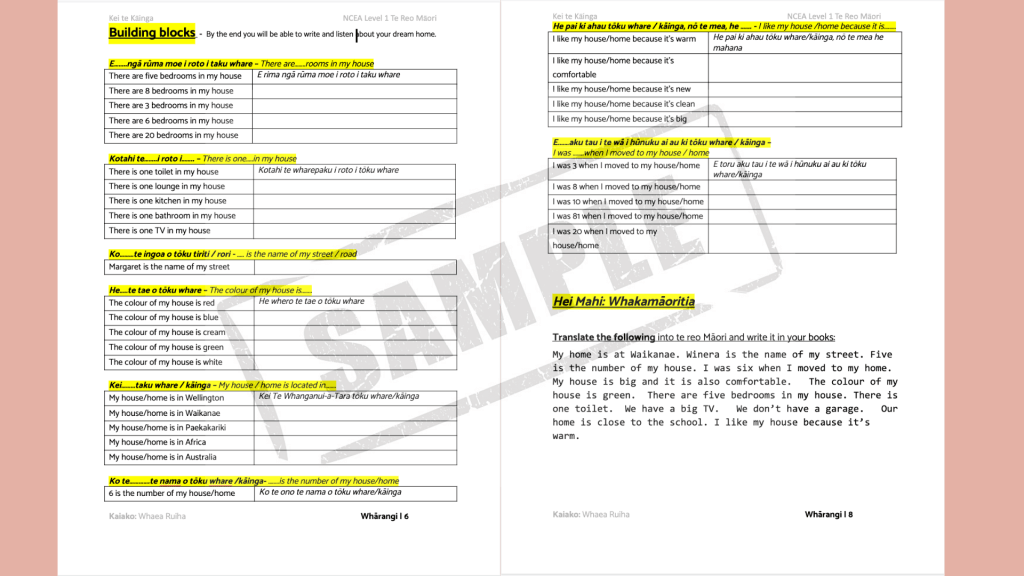
I differentiate my classroom by using a pukamahi or booklet. Why a booklet? In a preference survey, the students said they prefer engaging with learning te reo through hard copy material. It is a useful resource that helps to fill some gaps. It is pitched to all ability levels.
I started them with building blocks before translating the paragraph on page 8.
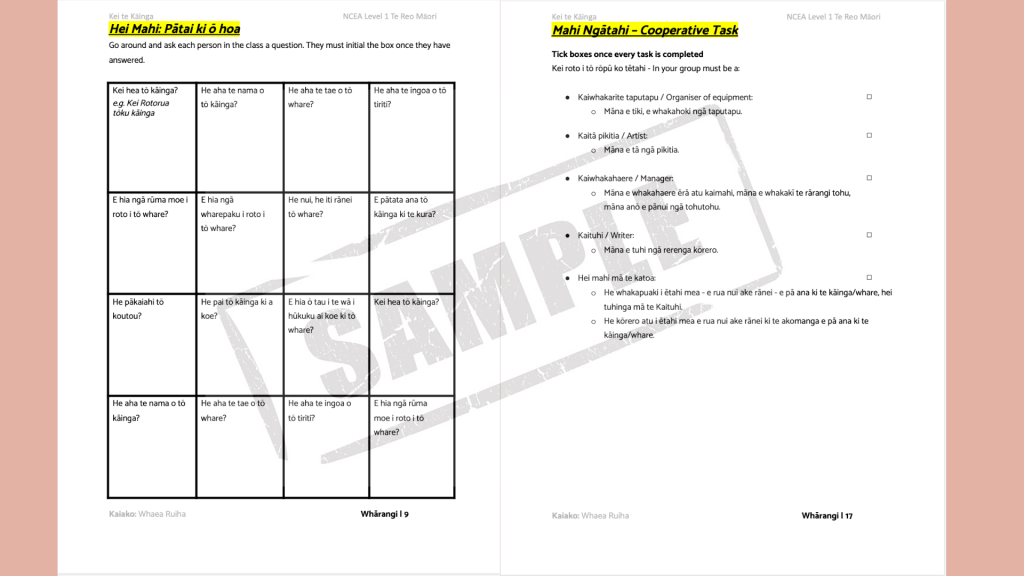
Tasks include:
- Asking and answering simple questions with classmates.
- Cooperative task-work.
- Higher-level sentence structures and a reading comprehension exercise towards the end of the booklet.
Pukamahi / Booklet

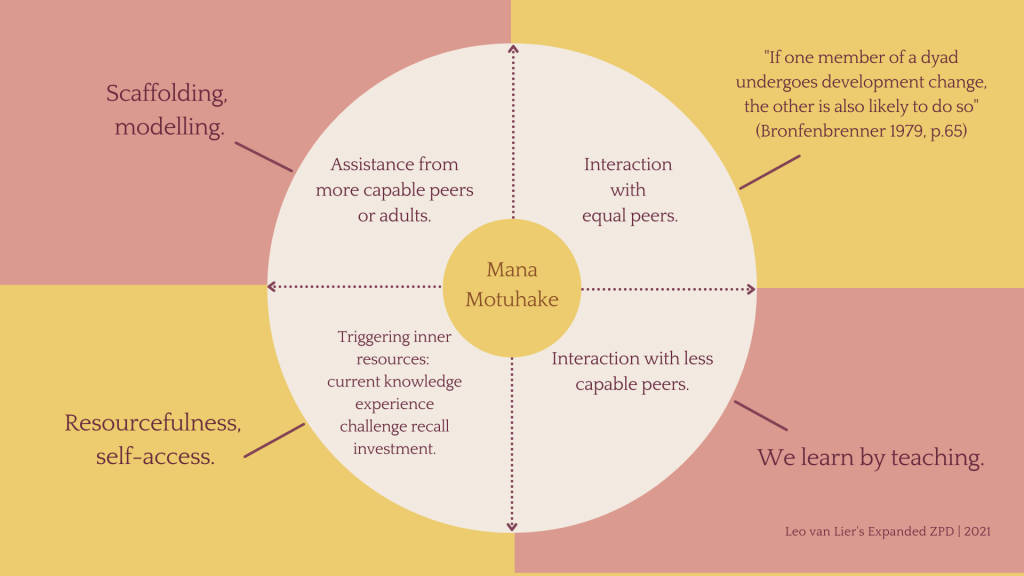
Expanded ZPD framework
The guiding framework of this inquiry is Van Lier’s Expanded ZPD (2004) Framework. I like this framework because it has a tuakana and teina feel. Mana motuhake is used here to mean learner independence and autonomy. So how do my tauira attain mana motuhake? I suggest two solutions, differentiation, and scaffolding, via the four contexts of Van Lier’s sociocultural theoretical framework. Scaffolding’s effectiveness is in the support that it offers, even if it is only temporary. Scaffolds are support structures teachers aim to remove when they feel their tauira can drive their learning and reinforce those they feel are still struggling to stand on their own. While they are being differentiated and scaffolded, tauira will also be supporting themselves and one another by traversing the four contexts of Van Lier’s Expanded ZPD framework. One part of the framework describes multiple encounters through getting assistance from more capable peers/adults through scaffolding. Another part details interactional relationships between and with equal peers: “If one member of a dyad undergoes development change, the other is also likely to do so” (Bronfenbrenner 1979, p. 65). The next part suggests learning by teaching others, that is, interaction with less capable peers. The last context describes a tauira who demonstrates mastery of the other three contexts while also accessing cultural capital (i.e., cultural knowledge, experience, challenge recall, investment).
Measuring Success
I tested my tauira again at the end of the term using the exact same format of the screening assessment, only this time it was on a familiar topic – Tōku Whare. All the students showed improvement, some more so than others. We see a major jump in confidence for tauira 1, 2, 4, 5, 6 and 7.

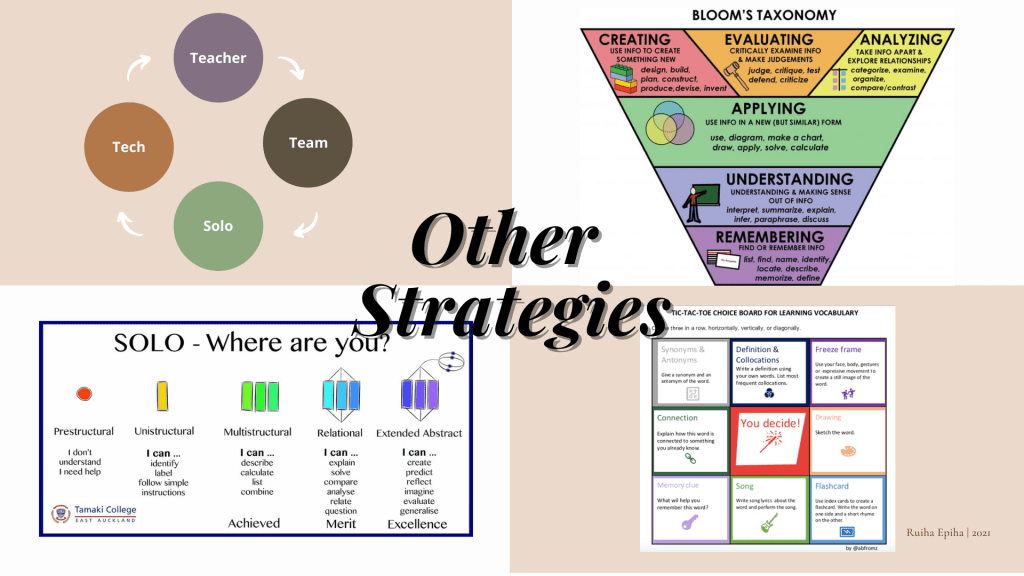
Other Interventions and Strategies to Try
Other strategies/interventions I would like to try are:
- Rotation Stations
- Bloom’s Taxonomy
- SOLO Taxonomy
- Choice boards
NGĀ TOHUTORO
Applebee, A.N., & Langer, J. (1983). Instructional scaffolding: Reading and writing as natural language activities. Language Arts, 60(2), 168-175.
Bishop, R., & Berryman, M. (2009). The Te Kotahitanga effective teaching profile. Set: Research information for teachers, 2(2), 27-33.
Bronfenbrenner, U. (1979). The ecology of human development: Experiments by nature and design. Harvard university press.
Ministry of Education. (2009). Te Aho Arataki Marau Mo Te Ako Te Reo Maori- Kura Auraki: Curriculum Guidelines for Teaching and Learning Te Reo Maori in English-Medium Schools: Years 1-13. New Zealand: Learning Media Limited.
Hogan, K., & Pressley, M. (Eds.). (1997). Scaffolding student learning: Instructional approaches and issues. Cambridge, MA: Brookline Books.
Timperley, H., Kaser, L., & Halbert, J. (2014). A framework for transforming learning in schools: Innovation and the spiral of inquiry (Vol. 234). Melbourne: Centre for Strategic Education.
Tomlinson, C. A., & Moon, T. R. (2013). Assessment and Student Success in a Differentiated Classroom. (n.p.): ASCD.
Vaioleti, T. (2013). Talanoa: Differentiating the Talanoa Research Methodology from phenomenology, narrative, Kaupapa Maori and feminist methodologies. Te Reo, 56/57, 191–212.
Van Hees, J. (1999). Diagnostic Oracy and Literacy Assessment in English: In the Four Modes of Listening, Speaking, Reading, Writing : Suggested Essentials & Recording Sheet Masters for All Students, for NESB Students. New Zealand: Kohia Teachers Centre, Auckland College of Education.
Van Lier, L. (2004). The ecology and semiotics of language learning: A socio-cultural perspective. Boston: Kluwer Academic Publishers.
| Standard / Competency | A student teacher |
| Standard 1: Learning-focused culture Develop a culture that is focused on learning, and is characterised by respect, inclusion, empathy, collaboration and safety. | – Develop learning-focused relationships with learners, enabling them to be active participants in the process of learning, sharing ownership and responsibility for learning. – Foster trust, respect, and cooperation with and among learners so that they experience an environment in which it is safe to take risks. – Demonstrate high expectations for the learning outcomes of all learners, including for those learners with disabilities or learning support needs. – Create an environment where learners can be confident in their identities, languages, cultures and abilities. – Develop an environment where the diversity and uniqueness of all learners are accepted and valued. |
| Tātaiako: Whanaungatanga Actively engages in respectful working relationships with Māori learners, parents and whānau, hapū, iwi and the Māori community. | – Can describe from their own experience how identity, language and culture impact on relationships. |
| Tātaiako: Manaakitanga Demonstrates integrity, sincerity and respect towards Māori beliefs, language and culture. | – Values cultural difference. – Demonstrates an understanding of core Māori values such as: manaakitanga, mana whenua, rangatiratanga. – Is prepared to be challenged, and contribute to discussions about beliefs, attitudes and values. |
| Tātaiako: Tangata Whenuatanga: Arms Māori learners as Māori – provides contexts for learning where the identity, language and culture (cultural locatedness) of Māori learners and their whānau is armed. | – Knows about where they are from and how that informs and impacts on their own culture, values and beliefs |
| Tātaiako: Wānanga Participates with learners and communities in robust dialogue for the benefit of Māori learners’ achievement. | – Demonstrates an open mind to explore differing views and reflect on own beliefs and values. – Shows an appreciation that views which differ from their own may have validity. |
| Tataiako: Ako Takes responsibility for their own learning and that of Māori learners | – Can explain their understanding of lifelong learning and what it means for them. Positions themselves as a learner. |
| Tapasā Turu 1: Identities, languages and cultures Demonstrate awareness of the diverse and ethnic-specific identities, languages and cultures of Pacific learners. | 1.1 Understands his or her own identity and culture, and how this influences the way they think and behave. 1.2 Understands the importance of retention and transmission of Pacific identities, languages and cultural values. |
 Te Kōpaki a Ruiha Epiha