DR. KATHIE IRWIN
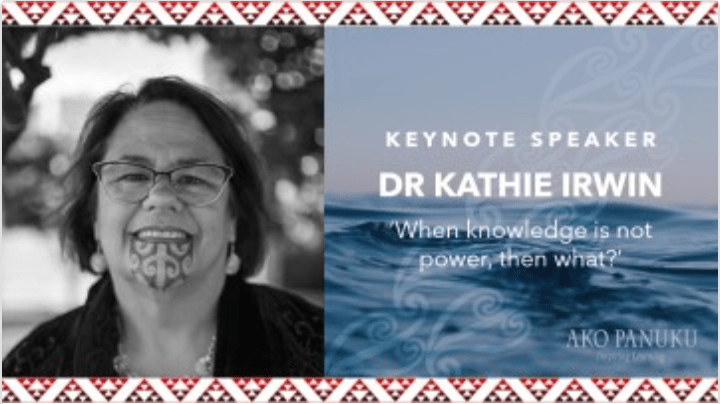
Ako Panuku Hui ā-Tau 2021
Ko Hikurangi me Moumoukai ngā maunga. Ko Waiapu me Nūhaka ngā awa. Ko Ngāti Porou me Rākaipaaka ngā iwi. Ko Tāne-nui-a-Rangi me Putaanga ngā marae. He whakapapa hoki mai i tāwāhi ki Ngā Motu ō Orkney, Scotland, me Ireland.
Kathie is a third generation wahine Māori educationalist. Public service and social justice are deeply embedded in Kathie’s whakapapa. She is passionate about building an Aotearoa that reflects the Treaty of Waitangi.
Below are some of the themes and kōrero captured from Dr. Kathie Irwin’s presentation.
In her kōrero, Dr. Irwin looks at education from a Māori point of view first, and from a public policy point of view second. She side-steps the education system, and goes straight to what matters most to us as Māori, and that is mātauranga Māori. According to Dr. Irwin, our power, as Māori, lies in our own knowledge systems.
In her drawing of the Māori education system, Dr. Irwin brings all the Māori ways of thinking and educating to the forefront of our minds. Dr. Irwin shows us the flaws of the machinery of the government of public service. She strips the machine back and builds it back up the way she believes will best serve those for whom it is designed.
Dr. Irwin: THE POWER!
Iwi/ Ngākau Māori: IS OURS!
“Amandla Ngawethu” or “Amandla Awethu” was a popular South African battle cry used in anti-apartheid rallies. The leader of the group would call out “Amandla” (power) and the crowd replied with “Ngawethu” or “Awethu” (to us). I imagined Dr. Irwin as the leader calling out “THE POWER,” and her followers replying with “IS OURS!” This was the general feels I got when listening to this wahine toa (warrior woman). Her kauhau (lecture) was packed with knowledge and enlightenment. The following are some themes and main points I gathered from Dr. Irwin’s powerful presentation.
Māori in Education
“Let’s be clear, in the space of creating kaupapa Māori-based change in the Crown Sector, knowledge is not power.”
Irwin, Oct 5, 2021
Decades and decades of research, undertaken by the Crown itself, successive Waitangi Tribunal Reports, and the best academics in the country, has not created the equitable change that is long overdue. Why not? What’s this about? What can we do about it?
Assimilation of Māori
It is well-known that the education system was set-up for Māori to fail. Initially designed to assimilate Māori into Pākeha society albeit as second class, industrial citizens, schools have always privileged the English language. This deliberate assimilative strategy dates back as far as 1847 in the Education Ordinance, only seven years after the signing of the Treaty of Waitangi. The Education Ordinance had four principles, which included industrial training and English as the language of instruction. Our people were given industrial training and second class education. Boarding schools were designed to take tamariki (children) away from the influences of the hau kāinga (home).
Māori Succeeding as Māori
The schooling system is still today a site of contention for Māori. It is a system that continues to privilege the Pākeha worldview. According to Dr. Kathie Iriwin, it is a system that does not reflect the Treaty of Waitangi. Although upcoming changes to our schooling system are looking like they may even the playing field, Dr. Kathie Irwin veers us away from the whakaaro (belief) that the schooling system is the only educational system. Although Dr. Irwin admits that schools are an important part of education, she states that “it is not the be-all end-all of education.” For her…
“…our power lies in our own knowledge systems. The key to Māori succeeding as Māori, is in how and where we harness our knowledge codes and systems.”
Irwin, Oct 5, 2021
Mātauranga Māori
Walking Backwards into the Future
For Dr. Irwin, to be able to envision our people and nation 100 years from now, we must look just as far back into our past. “As far forward as you look, you need to be able to look that far into our past to understand who we are and where we came from” (personal communication, Tuesday 5 October 2021). This harkens to the age-old proverb of our tūpuna: kia hoki whakamuri e koke whakamua ai – we must go backwards to go forward. “In our world view, we walk backwards into the future, facing our past.” Our past actions inform our future decisions. This is deeply embedded in our indigenous knowledge systems, in mātauranga Māori.
Collectivism
When we walk, we do not walk alone. We carry our ancestors, our iwi, hapū and whānau with us wherever we go. Mātauranga Māori does not place the individual on a pedestal. Our pepeha demonstrates how we as individuals do not exist by ourselves or for ourselves. Pepeha demonstrates a hierarchical system that prioritises our tohu whenua (landmarks), and the collective social structure over the individual. The individual is normally mentioned last in a pepeha. Unlike Pākeha social structures, in a Māori social structure the individual is one part of a holistic whole.
Kupe’s Law vs. James Cook’s Law
Justice Sir Joseph Williams recognised the dichotomy between the Māori and Pākeha knowledge systems. He named them Kupe’s Law and James Cook’s Law, which Dr. Irwin calls the ‘clash of two knowledge codes.’ Justice Sir. Williams defines Kupe’s Law as being relational and looks at who the individual was in relation to everyone and everything around him/her. These relational structures were where your essence or mana stemmed from. James Cook’s Law, on the other hand, was about property rights, and what you owned, what you had, how you traded with that, how to work with that was where your essence or mana came from.
Integrated Knowledge Codes
Mātauranga Māori is an integration of social, cultural, economical, and environmental knowledge codes, which all come together to help us understand solutions, issues, problems, to help us guide our thinking. When faced with a problem, we often return to our people, to our maunga (mountain), to our awa (river) to seek counsel, to heal or to ground ourselves in times of crisis. This is what our tūpuna meant when they advised us to return to our mountains to be cleansed by the winds of Tāwhirimātea – E hoki ki ō maunga kia purea koe e ngā hau a Tāwhirimātea.
Genealogical Positioning System (GPS) and Whakapapa
“Mātauranga Māori places us in our own GPS, not a global positioning system, but a genealogical positioning system [whakapapa].”
Dr. Irwin, 2021
Whakapapa (layers of names, stories and events) links us to our ancestors, to our atua (deities), to our origins, to all living things, to our taiaoa (environment), and thus to our whenua (land). Stories are what connect our whakapapa to the landscape. These links are also captured in our tauparapara (tribal incantations) and whakataukī (proverbs). “Whether we are connected to our whenua or not,” says Dr. Irwin, “they are connected to us.” Whether you are a ahi kā (person who keeps the fires burning on your ancestral lands), ahi teretere (travelling fire or person who lives away from their ancestral lands but returns often to tend to the fire at home), or ahi mātao (cold/extinguished fire or person who does not return to their ancestral lands), your bond to the land and the lands’ bond to you is one that cannot be severed for you are the river, and the river is you – ko au te awa, ko te awa ko au. Our whenua is the only place where we as Māori can truly claim as our tūrangawaewae or our place of standing, for nowhere else in the world can we make such a claim.
“So you can see that mātauranga Māori is a powerful part of who we are. Everything we know about being Māori has nothing to do with being at school,” states Dr. Irwin (2021). Education is more substantial than what we do at school.
Border-Crossing
“Educational success is one measure of success. What counts as success in the Māori world is worth investing in as well.” There is a lesson to be learnt from Tā Apirana Ngata’s letter to 8-year-old Pauline Bennett when he encouraged her to:
E tipu e rea mō ngā rā o tōu ao. Ko tō ringa ki ngā rākau ā te Pākheā hei ara mō tō tinana. Ko tō ngākau ki ngā tāonga a ō tīpuna Māori hei tikitiki mō tō māhunga. Ko tō wairua ki tō Atua, nāna nei ngā mea katoa.Tā Apiranga Ngata
Grow up and thrive for the days destined to you. Your hands to the tools of the Pākehā to provide physical sustenance. Your heart to the treasures of your Māori ancestors as an adornment for your head. Your soul to your God, to whom all things belong.
Dr. Irwin has interpreted this to mean for Māori to take the best of both worlds, to be expert border-crossers of both worlds.
It is thanks to our adeptness at being border-crossers, that we were able to retain our language and culture. Our tūpuna were examples of those who were adept border-crossers and therefore were fluent in both Te Ao Māori and Te Ao Pākeha. This is why century after century we have been able to respond to challenges we have faced, and still retain our language and culture.
Māori cultural infrastructure, our marae, offer us a space to challenge the Pākeha education system. Our marae is a place where we can retain our mana motuhake, our reo, our Mātauranga, and to teach and learn on our own terms. Without our marae, border-crossing would be near impossible.
“The power that we’ve always had, and the power that remains ours is to be adept at moving in and around and through those borders with the [same] grace that our koroua and kaumātua have and our kuia display and that our tīpuna set us [sic] as examples and the determination to make sure that we will inhabit any of the spaces we choose to, on either side of the Treaty, on our own terms….“
We have our own education system that we have retained in the face of colonisation and that is enabling us to serve Māori development, visions, and aspirations on our own terms. The future proofing of education and schooling in Aotearoa, in my view, is going to hinge on the ability of the Crown to be able to bring the reforms that it’s putting in place now to fruition.
The Māori cultural infrastructure, the Māori education system that our ancestors would recognise as ways that they understood being Māori and living in this beautiful land of Aotearoa, they would recognise those if they saw them here today and that’s because we’ve retained them and held on to them. We’ve adapted our abilities to move between worlds, without losing our integrity.
Concluding remarks
“The reason why our education has undergone such radical reforms is because we are harnessing the power of our own educational systems and codes, and we are celebrating them. So the moral of this kōrero is that knowledge is power, when it’s knowledge that we are able to acknowledge as part of our background, as whānau, hapū, iwi in Aotearoa and we take the power of that knowledge into any other context that we move to, including spaces like working with the Crown, working at the interface of the Crown, and taking what now is going to become in the schooling space the fabulous new opportunity to learn about our history in schools in New Zealand. That’s going to be strengthened by our ability to retain our links to the past.”
Self-Reflection
This kauhau got me asking myself, how am I embracing these old knowledge systems? How am I embracing it in my homes? How am I embracing it in my classroom spaces, in my work spaces, in my gym spaces, in my living space? How am I harnessing this power? Am I harnessing it? How do I carry it into all these other spaces and contexts?
At one point, Dr. Irwin showed us the Education System hierarchy chart of 1992, which placed Te Kohanga Reo (Māori immersion pre-school) at the very bottom and omitting Kura Kaupapa Māori (Māori immersion primary school) completely, which had been established by that time. Fast-forward to now, she challenges us to draw the current education system of today. How would the current Māori education system look like? Has it changed that much since 1992? Has it changed much since the Education Ordinance of 1847?
References
Irwin, K. (2021, October 5). When knowledge is not power, then what? [Keynote address]. Ako Panuku Hui ā-Tau, New Zealand. https://akopanuku.tki.org.nz/information/hui-a-tau-2021-ondemand/
 Te Kōpaki a Ruiha Epiha