AROHANUI ALLEN
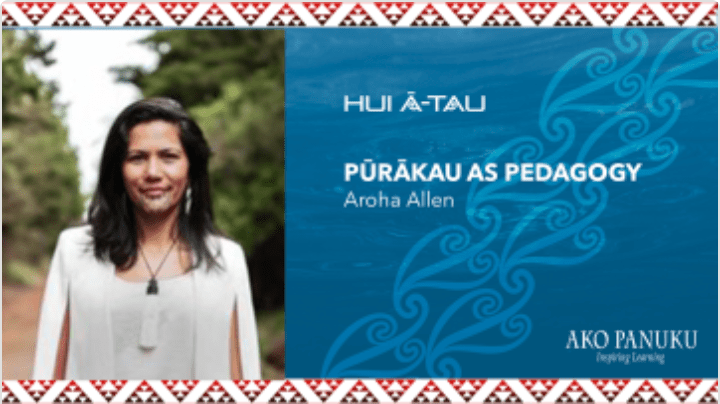
Ako Panuku Hui ā-Tau 2021
Ko Whakataha te maunga.
Ko Waitangi te awa.
Ko Ngātokimatawhaorua te waka.
Ko Te Waiū te wharekai.
Ko Te Rangiāwhiowhio te whare tūpuna.
Ko Taurangi te kōhanga reo.
Ko Ngaitāwakekitetuawhenua te hapū.
Ko Ngāpuhi, ko Ngāti Kahu, ko Te Rarawa, ko Ngāi Te Rangi, ko Ngāti Kahungunu ki te Wairoa ōku iwi.
Ko Arohanui Takangaroa Allen tōku ingoa.
Tokorua āku tamariki, ko Aramia rāua ko Ihaka o rāua ingoa. I kuraina au ki te kura karaitiana o Ngā Kākano o te Kaihanga Kura. I reira au tipu ai ki ngā rekereke o ōku mātua. I taku pakeketanga, i hūnuku mātou ko tōku whānau ki Te Tai Tokerau, ā, kei Te Kāreti o Te Tai Tokerau ahau e mahi ana ināianei nā, otirā, kei te Kaikohekohe ahau e noho ana.
Arohanui Allen is the Head of Learning | Te Puna Māori at Northland College. In this position, Arohanui works with a team of Year 9 teachers using pūrākau as pedagogy within a collaborative and project-based teaching and learning environment.
Arohanui feels blessed to work at a kura and with kaiako who place value on pūrākau ‘nō te kāinga’. The journey of using pūrākau started when Arohanui attended the 2019 Ako Panuku Hui ā-Tau. Ever since attending this conference two years ago, her journey has continued to evolve and adapt.
Arohanui’s goal [same goal as mine] is to see confident ākonga Māori coming out of our kura knowing exactly who they are and where they come from. She sincerely believes that embedding pūrākau into teaching and learning programmes can help towards achieving that.
Opening Statement:
Utilising pūrākau of Te Tai Tokerau as a unifying factor for our ākonga in Tau Iwa Kōtuitui, the kaiako at Northland College are working to implement integrated learning in a way that engages and challenges our ākonga. This workshop will let you take a look under the hood at the journey thus far, and the challenges that have come up as the journey has progressed. Experiences of leading this change at management level, as well as experiences of leading and working in the classroom will be shared.
Vision: they have rich history, particularly the whenua their kura sits on. It used to be a mahinga kai named Te Pārahirahi and Ōtuhi.
Baseline assessment: all tauira completed an initial assessment to get some baseline data. Where are our akonga at, what were their strengths, and were their work-ons? For the Year 9 and Year 10 cohort, we implemented an integrated project-based programme that was underpinned by pūrākau. The team she works in is a team of 3 – Te Reo Māori, English and Social Sciences. The tauira will choose a minor event within the major event of the battle of Ruapekapeka, for example, they found out that there was a young girl at that time in Ruapekapeka named Hikitene, she would have been between 10 and 12 at that time and her role within the battle was to get the mortars before they exploded, remove the wick, and take it back to the pā for the powder to be used in our pū (guns). A group of their tauira chose that minor event to hone in on.
Every group’s end-product will be a news report, reporting on the minor event with one student being the news reporter, and the other two being two different perspectives. Te Reo Māori fits in there as understanding roles and responsibilities (Level 4 of TMoA).
Imparting Mātauranga Māori in a collaborative, integrated and project-based way.
What can we find (as Kaiako) that we don’t do that we believe if we did it would disrupt our negative norm? She enrolled herself in a te reo Māori course, others read literature, others attended other conferences, and collectively we brought back our different matauranga. And honed in and decided on which approaches we would use and hypothesised what benefits would come out of this.
Inquiry question: How can we use traditional and historical pūrākau Māori to promote engagement in our classrooms so that we can accelerate the literacy levels of our students?
We envisioned and manifested our destination (as Wixon would put it) as a collective, and created integrated project-based programmes based on pūrākau from our takiwā, from our rohe, we went away and gathered what were some best approaches (this happened throughout the cycle, and did not happen in a linear way) and then they went out and did it. With its failings at times, but also with some great success. The challenge they faced was that it was brand-new for them out there, and it came with criticism from people. “We had to be vulnerable, we had to trust ourselves to take the risk, and to understand that what we were doing was not working. So why would we carry on with it. It’s about having faith in yourself and your intentions and getting some good practice behind you, some research behind you and going out and doing it.”
We reviewed and reflected on what worked and what didn’t work. At the start it was wide and broad. Students were given great scope. But over the course of the year we realised actually we need to bring it in. We need really defined rubrics. We need examplars. We need to show in our rubrics, what achieved looks like, and what excellence looks like. So they get an understanding exactly what it is we’re looking for here. Scaffolding is a massive part of our planning as a team. At the end of this term we will do our second assessment eAsttle because it covers literacy in all subject areas. We will soon see what our data tells us. Pre-lockdown, what our data shows us was, greater attendance, less disengagement. Even the fence-sitters tended to flip over to the engaged crew and smash out some mahi.
Successes:
- Greater engagement in class
- Increased student attendance
- Accelerated academic progress
- The transfer of knowledge
- Sharing best practices for our kids: brining what mātauranga they have gathered and trialling it – “mō ngā ākonga te take”
- Resource creation and sharing: creation of our rubrics and exemplars
- Being able to revitalise our reo, tikanga and mātauranga through the pedagogy of pūrākau is one of our greatest successes.
Challenges:
- “Aroha, do not teach these mokopuna lies about our tūpuna!”
- That information is not always readily available
- It does take a few cup of teas with Nan, and sifting through deeds of settlements and things like that
- Teaching te reo Māori and teaching mātauranga Māori, is not for the faint of heart because we don’t get the ten-pack ready made resource for you to just roll out. We actually have to go and create our own resources, but students understanding more about who they are, where they come from, the type of toto that runs through their blood. Makes it all worth it.
- Where do I find everything?
MY THOUGHTS: I could take this a step further and engage the community, the hapū/iwi in the creation of the programme.
References:
Allen, A. (2021, October 5). Pūrākau as pedagogy. [Conference address]. Ako Panuku Hui ā-Tau, New Zealand. https://akopanuku.tki.org.nz/information/hui-a-tau-2021-ondemand/
 Te Kōpaki a Ruiha Epiha