Friday 20 May 2022 |University of Waikato
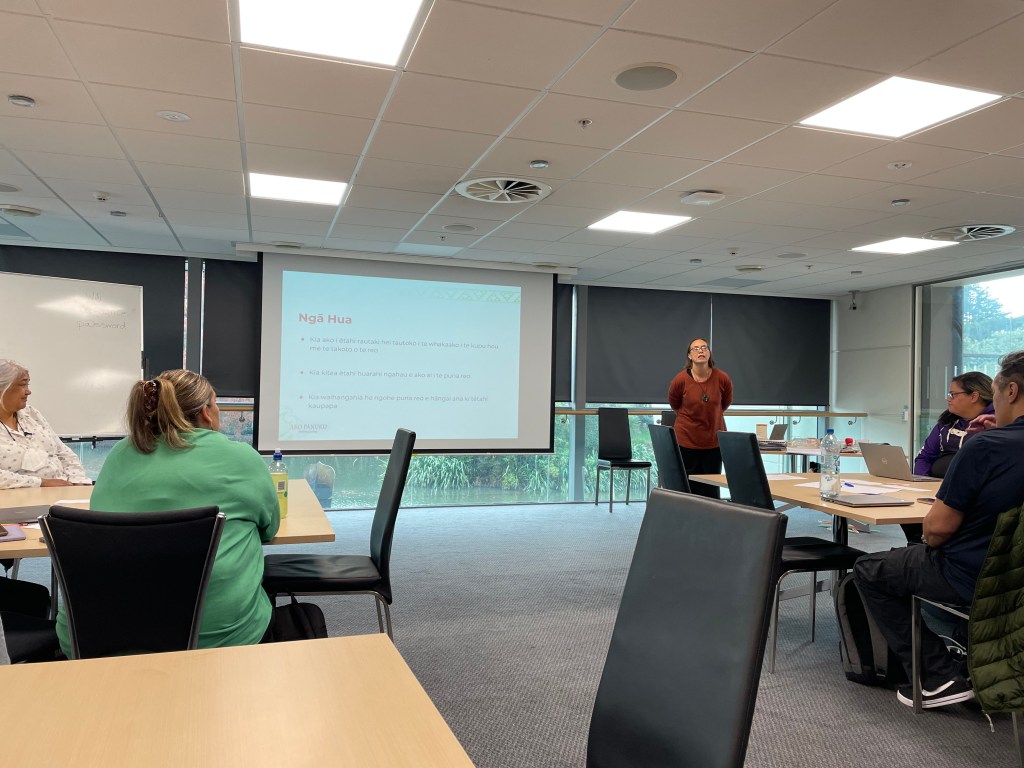
Kaikauhau/ Facilitator:
Rauhina Cooper
Ngā Hua Akoranga/ Learning Outcomes:
- Increase kaiako’s repertoire of second language strategies for teaching vocabulary and grammar
- To explore some fun and engaging ways to teach te reo Māori vocabulary and grammar
- To create an interactive activity about a given topic
Workshop Name: Kia Wana te Ako – Puna Reo
This was a 1-day workshop run by Rauhina Cooper at the University of Waikato in Hamilton. This workshop was designed to increase the repertoire of second language teaching strategies that kaiako can use to enhance their teaching of grammar and vocabulary to their ākonga.
There were seven strategies introduced for teaching vocabulary including:
- Tukuna, Ākongia, Ūnga (TAU) | Input, Recognition, Discrimination, Production and Extension (IRDPX by Jim Madden)
- Arawhata Arepa | Alpha Ladder
- Kāri Rarapa | Flash Cards
- Te Kimi Tikanga i te Horopaki | Guessing from Context
- Panga Kupu | Puzzles
- Kāri Rūpi | Loopy Cards
- Tīpare | Headbands
Grammar teaching strategies included whakarongo, pānui, tuhituhi, and kōrero tasks:
- Whakarongo me te tuhi (hei mahi whakarongo me te tuhituhi)
- He kupu kāore i te Hiahiatia | Unwanted Words (hei mahi pānui)
- Tūhonoa ētahi rerenga e rua (hei mahi tuhituhi)
- Te Kōrero Paki | Rory’s Cubes (hei mahi kōrero)
The above mentioned strategies have been tried and used across many years of teaching te reo Māori. A mix of contextualised and decontextualised language teaching strategies was chosen with a greater emphasis on contextualised and authentic language use. The strategies in this workshop have been selected because of their ease of preparation and use, and because they support good language teaching practice.
These techniques were selected to equip kaiako with a range of techniques for the modes of whakarongo (listening), kōrero (speaking), pānui (reading), and tuhituhi (writing) described in Te Aho Arataki Marau mō te Ako i te Reo Māori. Knowing a range of techniques keeps lessons interesting; provides repetition of language without ākonga becoming bored; and provides choice in selecting appropriate techniques (Nation, 1996, p.1). These techniques can be used in a class with ākonga working at different levels while still keeping them engaged. Once a kaiako is familiar with a technique, it can be adapted to use in any learning area of the curriculum.
When using a strategy for the first time, avoid using new text, an unfamiliar context or language that students are not familiar with. Let the strategy provide the challenge. If it does not work as expected the first time, reflect on what happened and what you could do differently next time e.g., were there too many new things happening in the task? Was the mix of students in a group of pair not right? Or how clear was your explanation of what to do? By using strategies multiple times students become familiar with how they work and can then focus on new language, new contexts, or new concepts.
Many of the strategies can be used together effectively, using the same piece of text or same list of vocabulary, This leads to deeper and more efficient teaching and learning for students. However, this is only a selection of many possible communicative learning teaching strategies. There are many more, and kaiako are strongly encouraged to keep trying a wide range of teaching strategies to make the learning more enjoyable and effective for students, and ultimately for the betterment and revitalisation of our language.
Until ākonga are familiar with the strategy, always:
- name the technique
- explain why the technique is being used
- provide any important tips for ākonga that will help them complete the task successfully
- clearly explain the procedure
References:
Nation, I. S. P. (1992). Teaching, Listening & Speaking, E.L.I Occasional Publication No.14. Victoria University of Wellington.
Nation, I. S. P. (n.d.). Teaching and Learning Vocabulary (Revised Edition). E.L.I. Occasional Publication No.7. Victoria University of Wellington.
Te Whakaako Kupu Hou – Teaching Vocabulary
Key Principles
- Low vs high frequency – spend most of your time on high frequency kupu.
- Decontextualised vs contextualised learning – balance the way new words are presented. Provide more opportunities for learning the kupu in context.
- Teach how to learn – ākonga need to have strategies on how to deal with new kupu they come across. Do not assume they known how to learn kupu hou or work out the meaning. Guessing from context is the most important learning strategy.
- Repetition matters – ākonga need to “meet” a new word multiple times (>7) to learn it.
- Reduce the learning burden – how kaiako teach words can help or hinder the learning.
Learning Burden
Learning burden = the amount of effort needed to learn and remember a word.
Reduce the learning burden by:
- Drawing attention to things/ideas/concepts/sounds, etc., that transfer easily from English, or from something they already know, e.g:
- pene sounds like pen (transfers easily)
- rongo is part of whakarongo (transfers easily)
- Teaching associated words separately, e.g:
- avoid teaching opposites together (e.g., whakakā, whakaweto)
- avoid teaching words that look alike or sound alike (e.g., mātou, tātou…)
- avoid teaching words that are associated with the same concept together (matau, mauī; runga, raro…; days, months….)
- avoid teaching words that are all the same type (e.g., all tūingoa, tūmahi, etc.)
- Teaching words in chunks, e.g., e haere ana; kei te noho; ko au; ki a koe
The following are resources I have created from this workshop and have used or intend to use in my classroom:
1. TAU | IRDPX by Jim Madden
Input, Recognition, Discrimination, and X for extension or Tukuna, Ākona, and Ūnga.
This is a scaffold strategy to introduce kupu hou. A listening and speaking activity that can be done as a whole class that uses images instead of text.
What do you need?
- Images/pictures of new words (online google or power point slides) or hard copies, large enough to see from a distance.
- Smaller sets of images with a matching set of words (flash cards) for possible follow up practise.
How does this strategy work?
Choose no more than 7 kupu hou at a time to introduce.
- INPUT – Hold or show one image/picture to ākonga and say the kupu hou. For example, “tahā”. Ākonga repeat after the kaiako. Repeat this process a few times with all 7 kupu hou.
- RECOGNITION – Blu-Tak all 7 images around the class or have all the images up on a screen. The kaiako says one kupu and ākonga point to the correct word. Repeat this a few times with all 7 kupu hou.
- DISCRIMINATION – Ākonga are required to make a choice at this stage. The kaiako shows one image at a time, for example, a picture of a tahā. The kaiako says two of the kupu hou, for example, “tahā” and “naonao”. Ākonga repeat back the correct kupu for the image shown. Repeat this process for all 7 kupu hou.
- PRODUCTION – At this stage the kaiako holds/shows one new image at a time and ākonga say the kupu hou without the scaffold of the kaiako. Repeat the process a few times for all 7 kupu hou.
- X or Extension – It is important to follow up the process with some activities to help embed the kupu hou. For example, memory, snap, bingo, quizlet, etc. Activities that involve moving the body are effective like charades or relay games. For example, the teacher calls out a new word and students race to find the correct image that is placed somewhere around the room. Activities that involve reading or writing could be used in subsequent lessons.
IMPORTANT: If the kaiako and ākonga get to the PRODUCTION stage and ākonga are finding it hard to think of the correct kupu hou, go back and repeat the INPUT, RECOGNITION and DISCRIMINATION stages.
2. Arawhata Arepa | Alpha Ladder
When do you use it?
At the beginning of a unit.
Why do you use it?
- To identify prior knowledge.
- To record information.
- To consolidate thinking.
- To document events, characters in books and plays, roles, issues, factors, or specialised terms.
- To record new words and key concepts.
How do you use it?
Students can complete Alpha Ladders individually or in small groups.
- Draw up an Alpha Ladder – or provide a template;
- List items on the Alpha Ladder;
- Next to each letter of the alphabet, ākonga write down a list of items they were introduced to during the topic e.g., specialised terms, key participants, significant events, or issues;
- Display in the classroom as a stimulus or reference for other activities;
- Add more columns as needed.
Example – Hei Tauira
This example shows the Alpha Ladder strategy in a Kura context. Either provide ākonga with a blank template for completion with key words that they need to understand. Alternatively, give ākonga the table with some parts already filled in. Once completed, put up on the wall to remind ākonga of key words needed in the unit of work being studied. You can add images instead of words in the ‘Kupu Māori’ column. You can also add columns for phonetics.
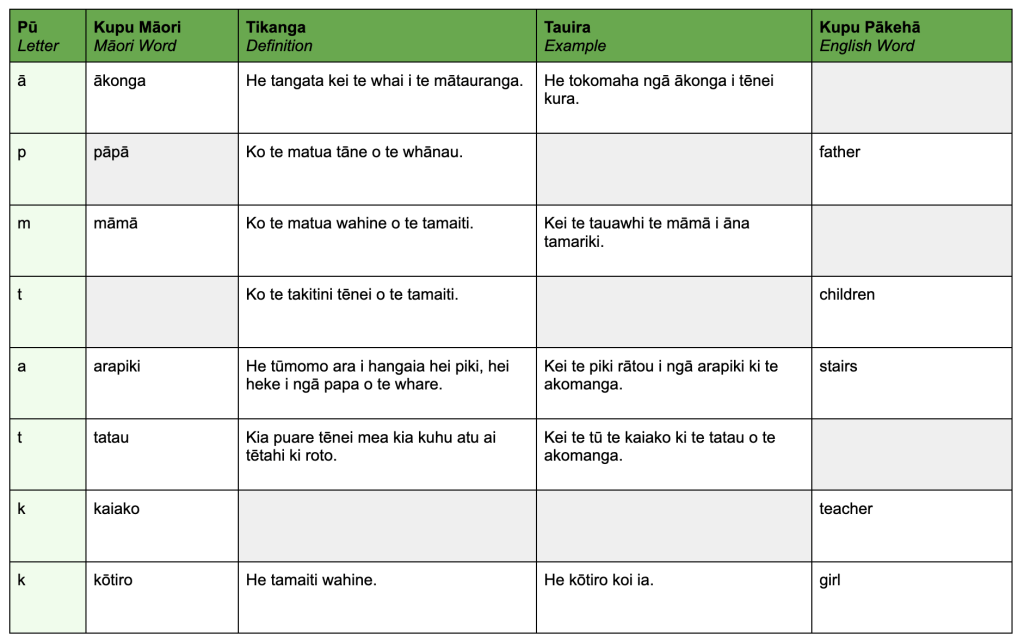
Reflection:
I did not use this strategy properly. I tried to get my ākonga to create their own, but in hindsight I should have created one and given it to them, such as the one above. I will revisit this activity.
Term 3, week 5: I tried it again with some modifications – I allowed ākonga to enter the definition in te reo Pākehā. When I asked the ākonga how it worked for them, they said they found it quite strenuous and difficult to complete . I need to give them less kupu. I may have overburdened them with too many kupu.
3. Kari Rarapa | Flashcards
- Using flashcards is a more effective teaching strategy than giving word lists.
- Providing the English translation in different ways, e.g., use flashcards for playing games such as Memory.
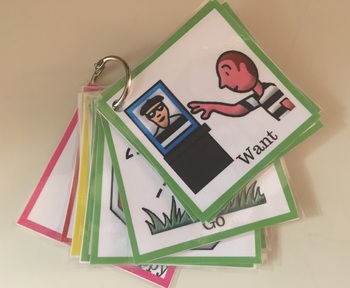
- Put the cards on a key ring (see image below), so learners can carry them easily and use them regularly.
Tips to give ākonga:
- Say the kupu while trying to think of the translation.
- Re-arrange the cards so that the sequence varies each time.
- Put the most difficult kupu at the beginning so that you give them extra attention.
4. Te Kimi Tikanga i te Horopaki | Guessing from Context
This is the most important strategy for learners to master.
When do you use this strategy?
- When the ākonga is still building their vocabulary.
Why do you use this strategy?
- To activate student’s prior knowledge.
How do you use this strategy?
- What type of word is it, e.g., tūmahi (verb), tūmahi oti (stative), tūmahi whiti (transitive verb), tūmahi poro (intransitive verb), tūmahi wheako (experience verb), tūāhua (adjective), tūingoa (noun), tūmahi hāngū (passive verb), tūkē (adverb), tūwā… etc.?
- What other words are around the unknown word that might give a clue to its meaning (e.g., if the word is a tūāhua what is the tūingoa that goes with it?)
- Are there other clues in the sentence?
- Look at the sentences around it. How are they related?
- Use the knowledge from these questions to guess the meaning of the word. Check that the guess is correct – if you replace the unknown word with your guess, does the sentence make sense?
5. Panga Kupu | Puzzles
When do you use them?
During the unit of work.
Why do you use them?
- To make learning fun.
- To help learners retain and practice using new vocabulary.
How do you use them?
Panga Kupu Mahitahi
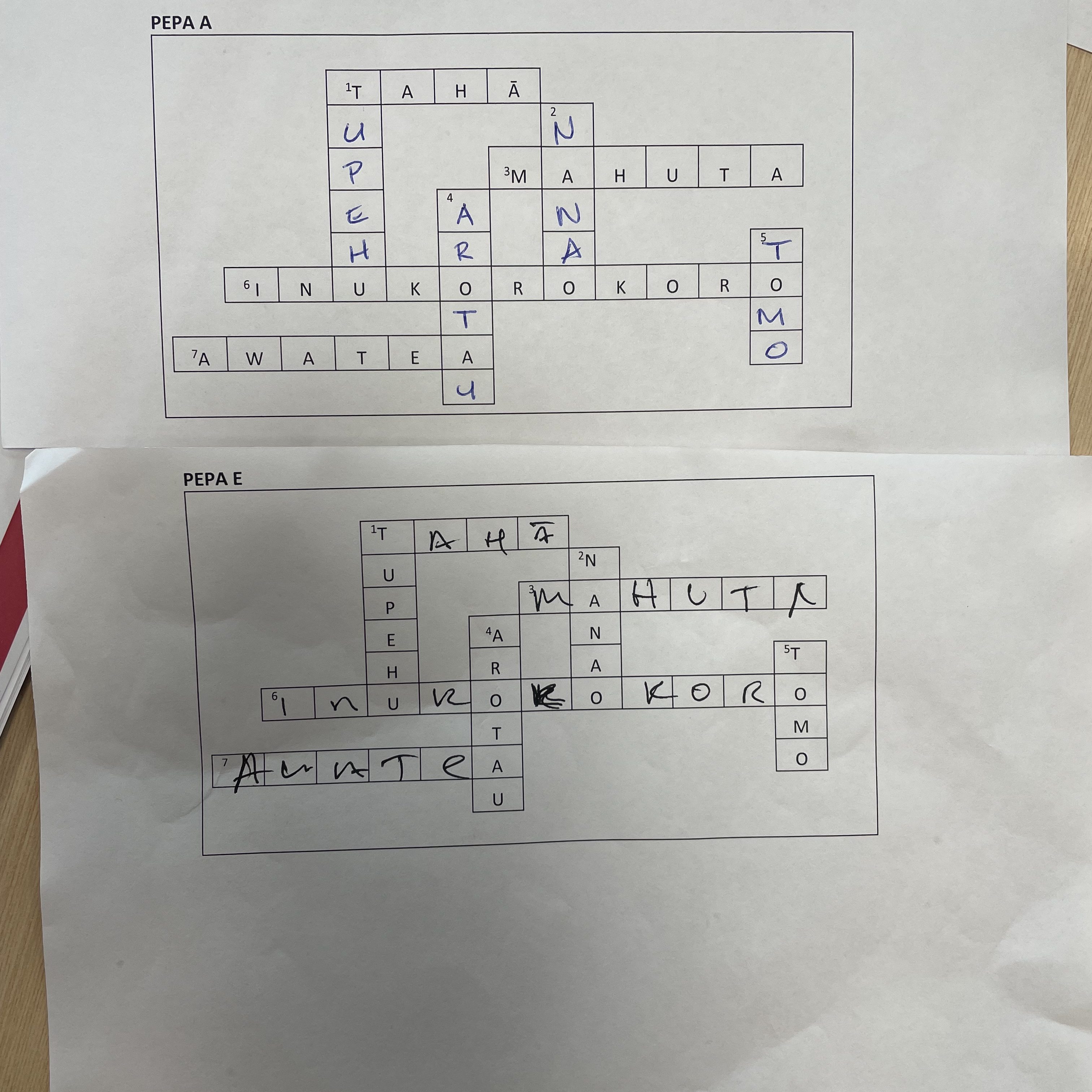
- You may like to create two versions of the same crossword – one with ‘Down/Whakararo’ words, the other showing the ‘Across/Whakapae’ answers.
- Provide one set of crosswords for each pair of students.
- Prepare a crossword that contains kupu relating to the topic or language feature being studied.
- Give each learner in a pair a version of the crossword that is only partly complete. Give ākonga A the vertical words, and ākonga E the horizontal kupu. Neither ākonga has the definitions of the kupu.
- All ākonga with Sheet A get together in a group to discuss how they can explain what is on their sheet. All learners with Sheet E do the same.
- Then they split into pairs (each pair comprising leaners with a Sheet A and Sheet E) to complete the crossword by asking each other for the definitions of the missing kupu.
- The partner can only give a definition or explanation of the kupu. They must not give the actual word. For example: ākonga A asks, “He aha te kupu kei 3 whakararo?” If the kupu us “kapu”, ākonga E might say, “He mea hei pupuri inu, he puritanga i tōna taha..”
Example – Hei Tauira (from the workshop)
Panga Kupu Mahi Takitahi
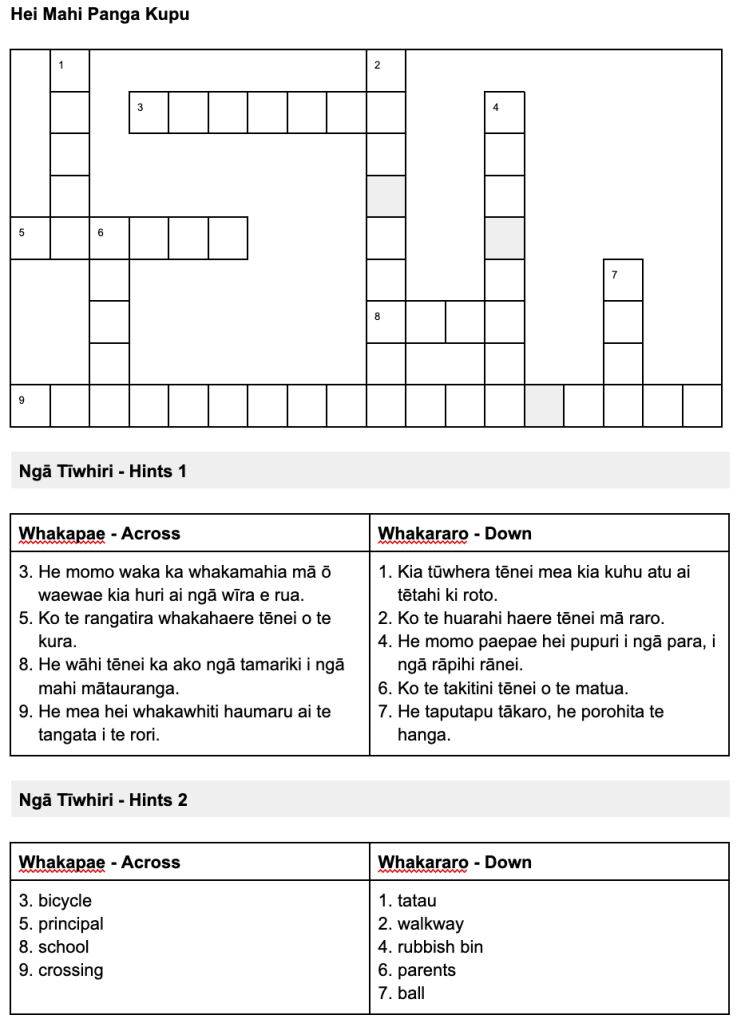
- Provide a blank crossword template based on the words to be learnt
- Provide clues in English or Māori. You may like to use images instead.
Example – Hei Tauira
6. Kāri Rūpi | Loopy Cards
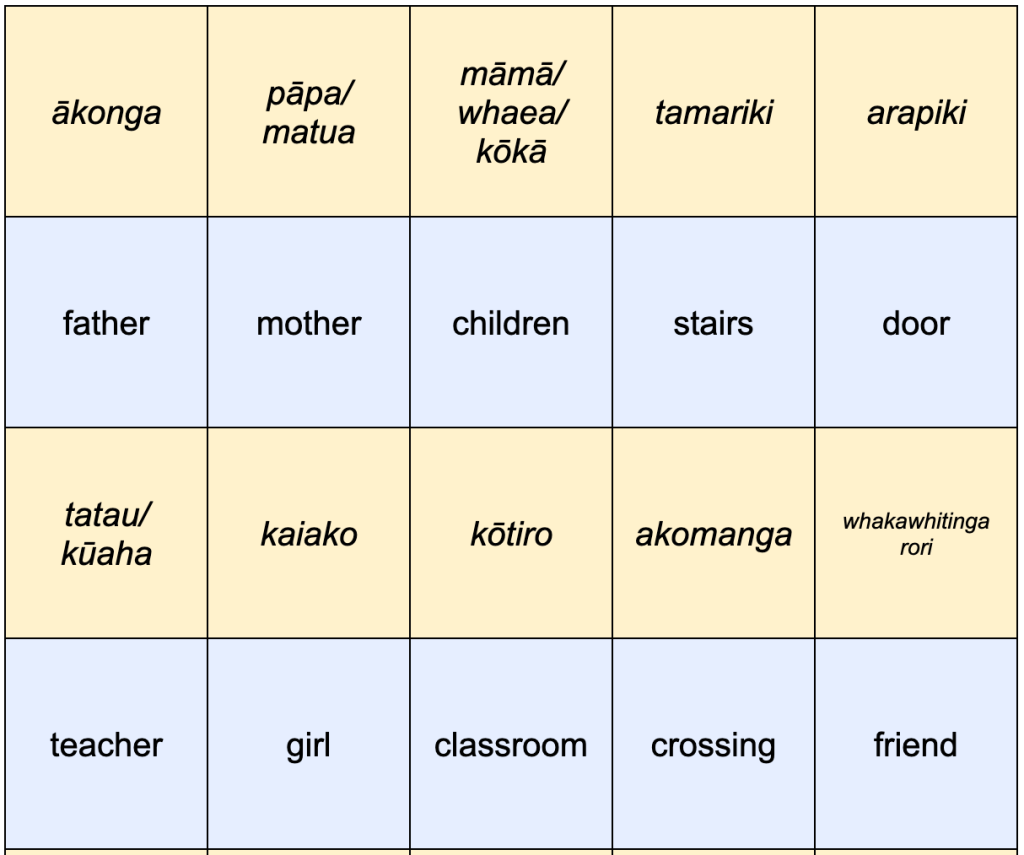
This is a form of dominoes. Ākonga can play Loopy either individually, in pairs or in small groups.
How do you use these?
- Create as many cards as you need for the words to be learned, including one start (Tīmata) card and one finish (Mutunga) card
- Shuffle the cards
- Deal cards out to ākonga – 1 card per ākonga
- The player with the ‘Tīmata’ card reads out the phrase at the bottom and lays the card on the table facing up
- Each player checks the word at the top of their card for the matching translation/answer/definition to that phrase
- The player with the matching translation/answer/definition at the top of their card calls out the answer
- The player with the matching translation/answer/definition at the top of their card then proceeds to read out the phrase at the bottom of their card before linking their card to the ‘Tīmata’ card (like Dominoes)
- The game continues as per instructions 5-7 until all the cards have been linked together
Example – Hei Tauira
The following is an example of Loopy Cards I have created.
7. Tīpare | Headbands
This is a fun way of learning and embedding new vocabulary. Tīpare also integrates whakarongo and kōrero through questioning and answering.
What do you need?
- a set of vocabulary cards (pictures or kupu). Alternatively use the KŪ PŪ KUPU cards or the Charades App
- a headband for each ākonga or cello-tape
How do you play this kēmu?
- Each ākonga has a card either on their tīpare or cello-taped to their back (they must not see their card).
- Ākonga ask questions amongst each other to identify what the picture on their card is. For example; He aha taku tae? He aha taku āhua? He mea ora ahau? Ka kite ahau i te pāmu?
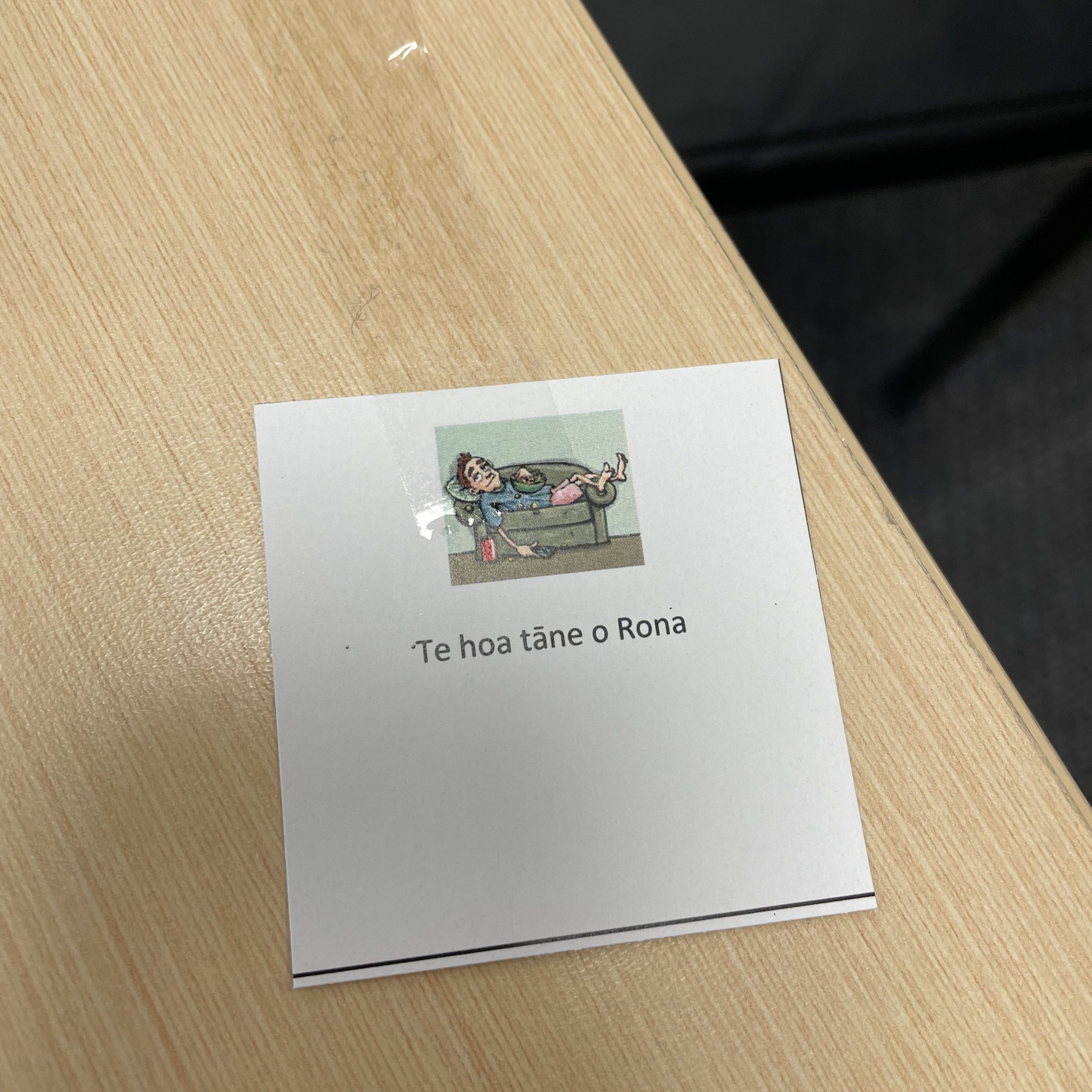
Example – Hei Tauira (from the workshop)
This was cello-taped to my back. It formed part of a group of vocabulary we had learned through the story of Rona and the moon. The word for this tīpare was ‘inukorokoro’, which describes Rona’s husband who was lazy.
Te Whakaako Wetereo – Teaching Grammar
Key Principles – Ngā Mātāpono
- Build up your own known – ensure you, as the kaiako, understand the grammar and rules of the language. Don’t guess or make it up!
- Grammar is not just about riles – it includes all the things we need to ‘know’ about the language in order to use it effectively, e.g., how it sounds, how it is written, the different types of language.
- Balance decontextualised and contextualised learning – there are times when it is important to focus on language rules and explicitly teach grammar, but there should be more opportunities to discover and practise those rules in context, with real languag examples.
- Teach how to learn – don’t assume ākonga know what to do with the grammar you explain in class. Teach them strategies to learn it.
- Make it fun – all language learning should be fun, including grammar!
All language learning should be fun, including grammar!
Rauhina Cooper, 20 May 2022
MĀ TE WHAKARONGO – LISTENING
1. Whakarongo me te tuhi
Why do you use this task?
To help ākonga focus on specific types of words and phrases.
When do you use this task?
Use it when you want ākonga to really notice not only individual kupu (e.g., tūmahi, tūingoa…) but also the types of grammatical words (pūmahi, pūingoa, pūriro, tūkē, pūmua, pūmuri…etc.) that they commonly appear next to.
What do you need?
A short piece of text that contains examples of the structures or words you want ākonga to learn.
How does this task work?
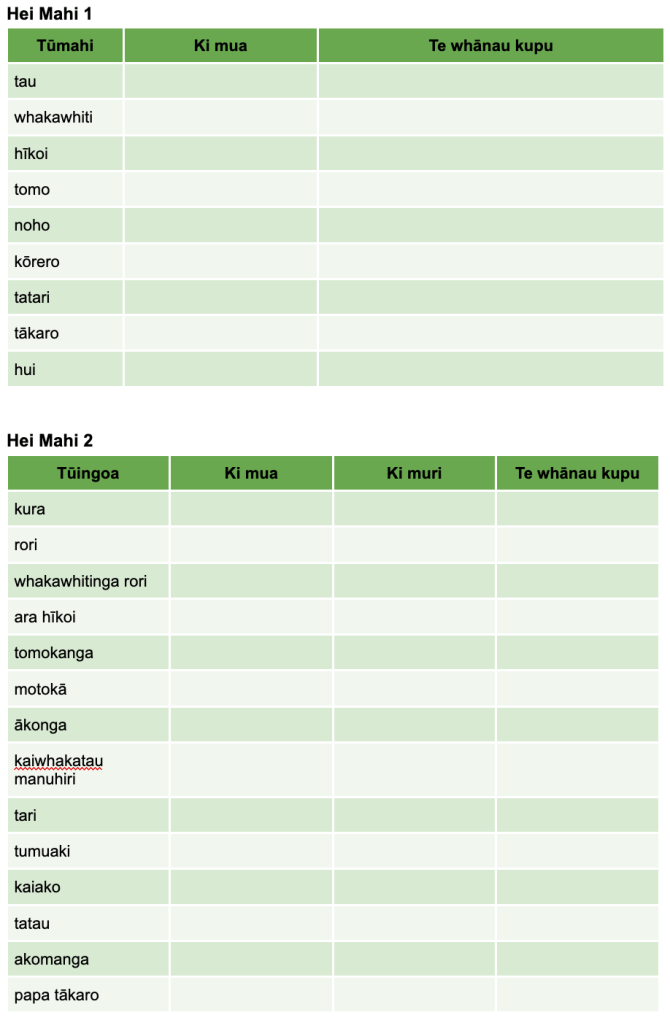
- Write a certain type of word (e.g., tūmahi, tūingoa, etc.) from the text on the board, in the order they will be heard.
- Ākonga listen carefully to the text being read and write the kupu they hear before (and after) each of the words on the board.
- Discuss the types of words that come before the selected word type.
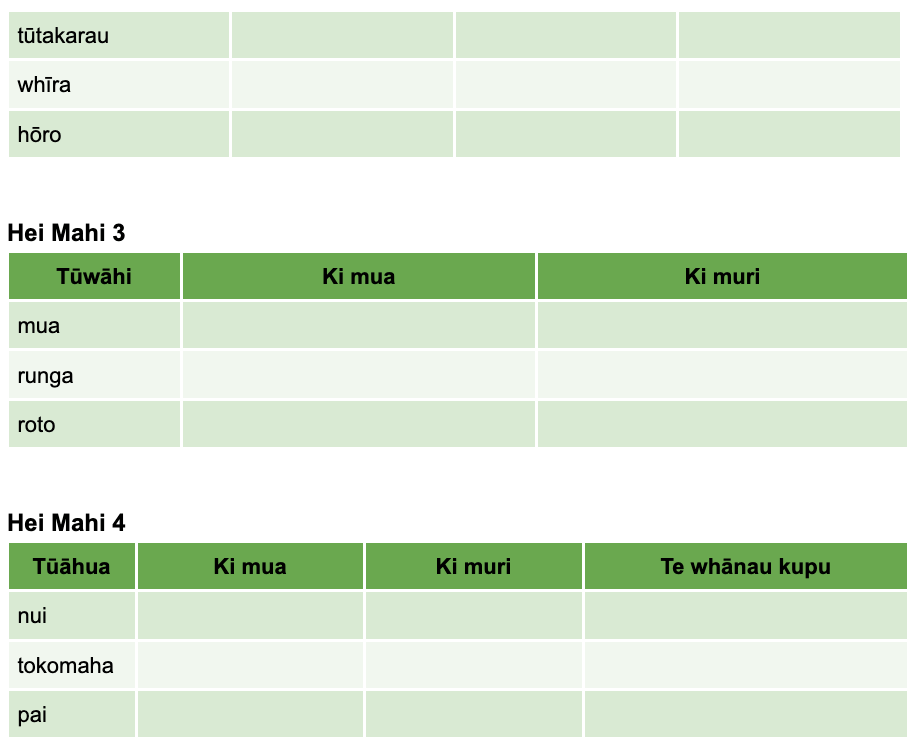
Example – Hei Tauira
Te Pānuitanga mō Te Kura
Ko tōku kura tēnei. Kei mua i tōku kura he rori, he whakawhitinga rori, he ara hīkoi, me tētahi tomokanga nui. Ka tau mai ngā motokā ki te kura mā te rori. Ka whakawhiti mai ngā ākonga i te whakawhitinga rori. Ka hīkoi mai ngā ākonga ki runga i te ara hīkoi. Ka tomo mai ngā ākonga mā te tomokanga. Ka noho te kaiwhakatau manuhiri ki roto i te tari. Ia ata, ka kōrero te tumuaki ki te kaiwhakatau manuhiri. Ia rā o te wiki, ka tatari ngā kaiako ki ngā ākonga ki te tatau o ngā akomanga. Tokomaha ngā kaiako, tokomaha hoki ngā ākonga. I te wā paramanawa me te kai rānui, ka tākaro ngā tamariki ki runga i te papa tākaro, te tūtakarau, me te whīra. Ka hui te kura katoa ki roto i te hōro. He pai taku kura ki a au.
MĀ TE PĀNUI – READING
2. He Kupu Kāore i te Hiahiatia | Unwanted Words
Why use this ngohe?
It forces ākonga to look very carefully at every word in a text and make sense of what it means.
How does this ngohe work?
- Prepare a text with one kupu added incorrectly into each line. Me tino hē rawa atu te noho o te kupu ki te whiti/kōwai. The error should make the sentence grammatically incorrect.
- Tell ākonga how many kupu are incorrect (i.e., 1 per line, xx in total)
- Ākonga identify the incorrect kupu by carefully reading each sentence.
Example – Hei Tauira
Find and count the kupu that do not sit well.
I a māua e pātata atu ana ki te kura, I kite tumuaki ahau i tōku hoa a Leila e tatari kaiako ana ki te ara hīkoi i tērā taha o te whakawhitinga rori. Nō reira, I whakawhiti māua tākaro i te whakawhitinga kātahi ka tomo atu mātou ki te tomokanga ki mua hui o te kura. Ka kuhu atu ki te tatau o te tari ki reira mātou i tūtaki ai ki te kaiwhakatau manuhiri o te kura. Kāhore he kaiwhakatau manuhiri i kō atu mō motokā te manaaki manuhiri. E ai ki te kaiwhakatau manuhiri, e ono rau waru tekau ngā ākonga kua mua uru ki Te Kāreti o Tāmaki. He kura mā ngā tama me ngā kōtiro.
MĀ TE TUHITUHI – WRITING
3. Tūhonoa ngā rerenga e rua
Why use this ngohe?
This activity practices the use of conjunctions, adjectives, and relative clauses.
How does this ngohe work?
- Give ākonga pairs of sentences
- Ākonga must join the sentences together to make one sentence.
For Example – Hei Tauira
Kua ngenge ia. Kāore ia i te haere
Kāore ia i te haere nā te mea kua ngenge ia.
Tokorua aku tuahine. He tamariki ake rāua i a au.
He tamariki ake āku tuahine e rua i a au.
Nā Witi Ihimaera i tuhi i te pukapuka. He pai taua pukapuka ki a au.
He pai ki a au te pukapuka i tuhia e Witi Ihimaera.
 Te Kōpaki a Ruiha Epiha