DAY 1 І Monday 19 April, 2021
Place-Based Learning & Local Curriculum
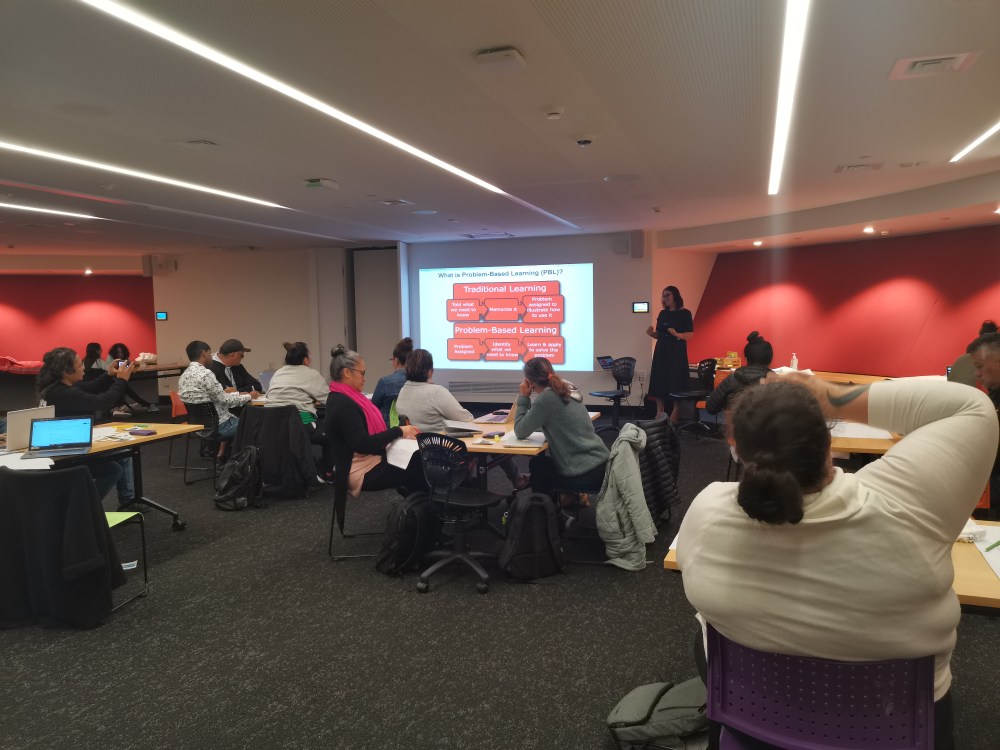
Local curriculum design is “knowing where your feet are” (Penetito, n.d.). According to Penetito we must “begin where our feet are” when designing our curriculum and giving credence to those stories told by the ancestors. Place-based education is where you go to a place to learn. You don’t learn about the stream; you go to the stream. You are learning at the place, about the place. Our community is a rich resource for learning. According to Rachel Tūwhāngai, “The community is the classroom, and the classroom is the community. You don’t learn about what is happening there; you go out there” (personal communication, April 19, 2021). To take the learning to the place is at the heart of interdisciplinary education, and this is what Dewey espouses. These ideas tie in nicely with the local curriculum. So where to from here? After ākonga have arrived at the place of interest, inquiry learning strategies are employed by kaiako to take the ākonga to the next stage of their ako journey.
Inquiry Learning and Design Thinking
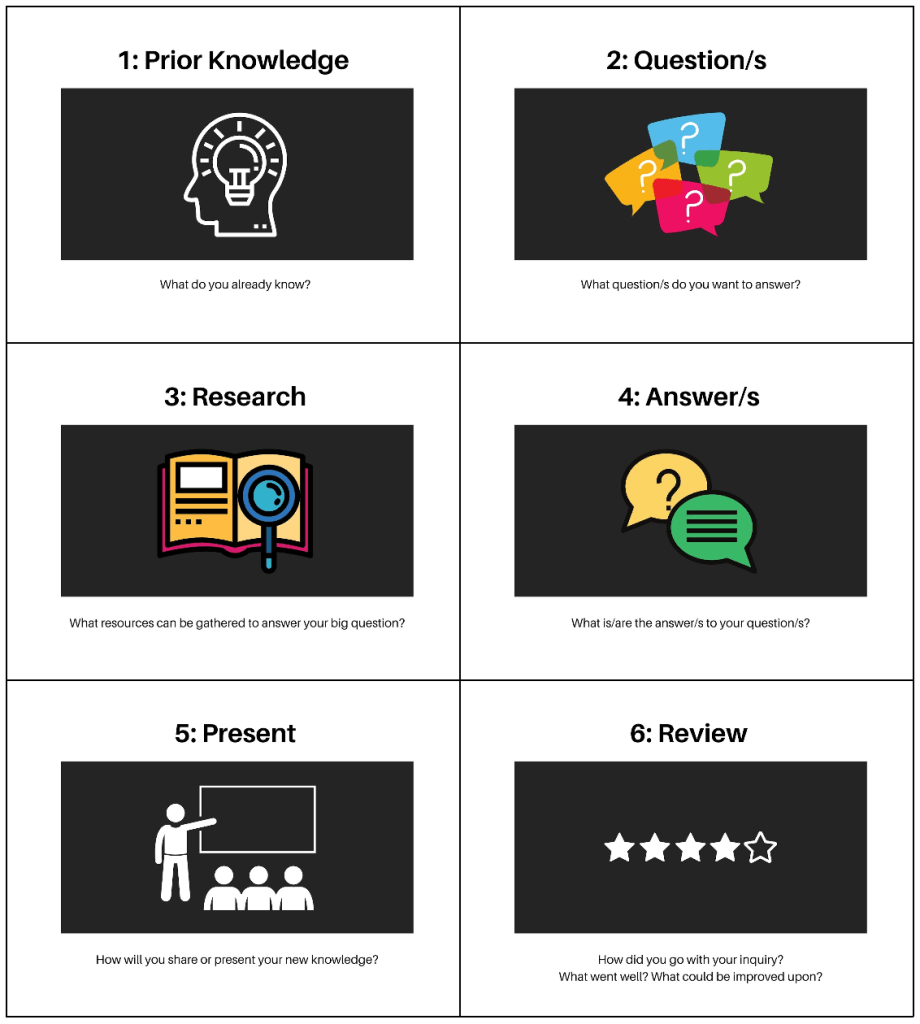
Inquiry learning is an inquisition into a topic or kaupapa. With inquiry learning, you start with a brainstorming process (in groups or individually) to activate ākonga prior knowledge. Rachel provided us with cards to guide us through the six stages of the inquiry process (see Figure 2 for my rendition of her cards).
Six stages of the inquiry learning process:
- Prior knowledge – what do you already know about the topic?
- Question/s – what question/s do you want to answer?
- Research – what resources can be gathered to answer your question/s? What resources are needed to answer your question/s? What strategies can we use to gather the information?
- Answer/s – what is/are the answer/s to your question/s? How will your turn the information gathered into knowledge?
- Present/Share – how will you share or present your new knowledge? Examples include: video, power point, google slide, website, essay format, book, haka, waiata, art piece, Tik Tok.
- Review/Feedback – how did you go with your inquiry? What went well? What could be improved?
Zone of Proximal Development (Vygotsky, 1978)
Inquiry learning, according to Rachel, is underpinned by Vygotsky’s ZPD (Zone of Proximal Development) theory (1978). ZPD is defined by Vygotsky (Ibid) as “the distance between the actual developmental level as determined by independent problem solving and the level of potential development as determined through problem-solving under adult guidance or in collaboration with more capable peers” (p.86). In simple terms, ZPD is the distance between what ākonga can do with support and without support. Rachel uses the ZPD to draw a continuum line to pinpoint where the ākonga is now and where they want to go. In the centre is the zone of proximal development where the kaiako carefully scaffolds and guides the ākonga to get to where they need to go.
Constructivism
To talk about inquiry learning is to also talk about constructivism. Constructivism is when ākonga are constructing or adding new knowledge to their current schemata rather than being passive recipients of knowledge. The ākonga determines what they want to know, and it is the kaiako’s role as the facilitator to guide them to the answers. Therefore, inquiry learning is very much learner-centred. Click here to learn more about constructivism theories and principles and how they apply to teaching and learning.
Strategies to Organise and Gather Information
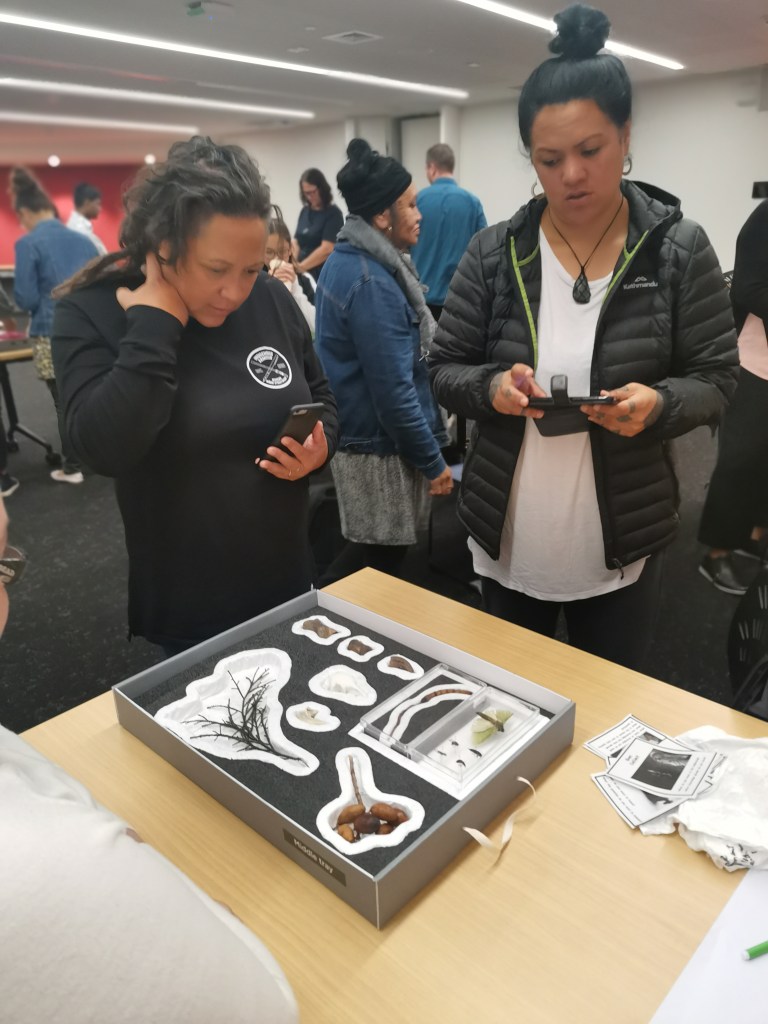
When teaching ākonga strategies to organise and gather information the following instructions were given:
- Decide on a topic that you would like to investigate further (3 minutes)
- Group your ideas using symbols (e.g. circle, triangles, squares, kōru)
- Name the groups/symbols (these would become your headings)
- Generate one question per heading
Rachel stresses the importance of teaching strategies to organise and gather information. We as kaiako must explicitly teach ākonga how to take notes, how to identify main ideas and key words. It is not good practice to instruct ākonga to find the information, to bring it back and make a google slide presentation. No! Rachel states, “We have to teach them how to select and reject information, how to take notes, how to bullet point, how to summarise, how to paraphrase. If we don’t teach these things, it is plagiarism. It is not their own kōrero” (personal communication, 19 April, 2021).
Ethics
- We spoke about intellectual property rights issues regarding the tapu nature of some kōrero tukuiho that should never be shared publicly.
- We also discussed how to search the internet safely when gathering information (i.e. keyword searching)
NGĀ TOHUTORO
 Te Kōpaki a Ruiha Epiha